
Overview
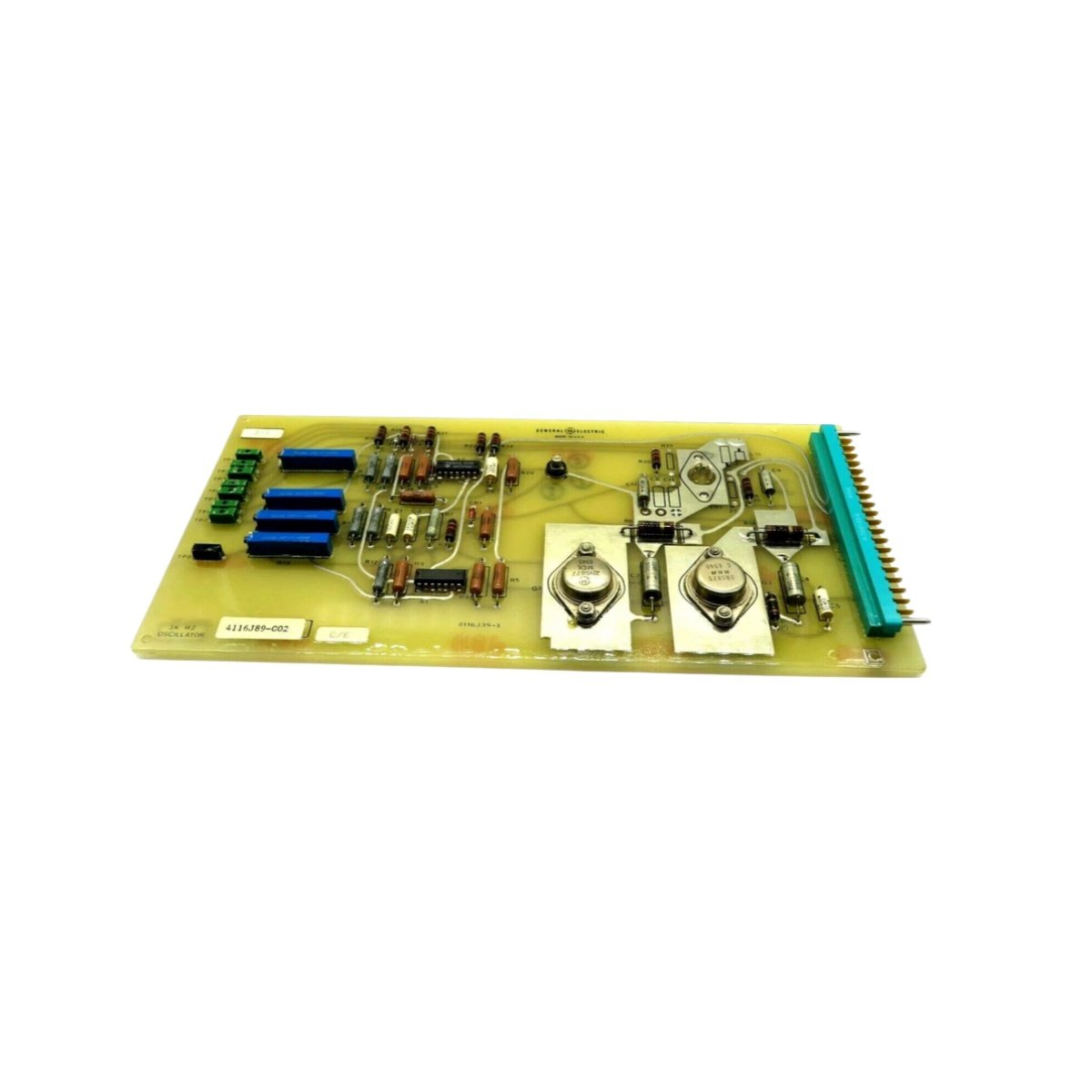
The 4116J79-G02 belongs to the GE family of vibration monitoring boards for turbine control systems. Engineers deploy this board to process vibration signals from two independent measurement channels. Consequently, it feeds real-time vibration data into the protection and monitoring racks.
Key Technical Specifications
The 4116J79-G02 accepts two separate vibration inputs and conditions each signal independently. Moreover, it supports proximity probe and velocity transducer sources. The table below lists the core parameters.
| Parameter | Specification |
|---|---|
| Product Type | 2-channel vibration board |
| Function | Vibration signal conditioning |
| Input Channels | 2 independent channels |
| Input Sources | Proximity probe, velocity transducer |
| Input Signal Range | 0–10 VDC or 4–20 mA |
| Frequency Response | 4 Hz to 1,000 Hz |
| Output Signal | Buffered analog, 0–10 VDC |
| Channel Isolation | 1,500 VAC between channels |
| Supply Voltage | ±15 VDC or 24 VDC |
| Operating Temperature | 0 °C to +60 °C |
| Storage Temperature | –40 °C to +85 °C |
| Humidity | 5–95%, non-condensing |
| Board Dimensions | 160 mm × 100 mm × 20 mm |
| Weight | Approximately 0.3 kg (0.66 lb) |
| Mounting | Rack slot, card cage |
| Compliance | CE, UL |
Installation and Interface Details
The board slides into a standard card cage slot inside the monitoring rack. Field signals then arrive through backplane connectors, which reduce external wiring. Furthermore, each channel operates independently, so a fault on one channel cannot affect the other. As a result, technicians achieve dependable dual-channel monitoring with minimal cabling.
Signal Processing and Output
Each channel conditions its input signal and produces a buffered analog output. Meanwhile, the 4 Hz to 1,000 Hz frequency range covers most rotating machinery applications. Additionally, the 1,500 VAC channel isolation prevents cross-talk between measurements. Therefore, the board delivers accurate vibration data for turbine protection and diagnostics.
Environmental and Mechanical Ratings
The board operates from 0 °C to +60 °C in typical control room conditions. Moreover, the compact card cage format fits standard monitoring racks. The sealed construction tolerates 5–95% relative humidity without condensation. Consequently, the board suits steam turbine generators, gas turbines, and large compressors.
Why Engineers Choose This Board
This board offers several practical advantages. First, it processes two channels in a single rack slot. Second, it accepts both proximity probe and velocity transducer inputs. Third, its channel isolation ensures clean, independent measurements. Therefore, maintenance teams simplify troubleshooting and reduce spare-part inventory.
Details
| Weight | 1.5 kg |
|---|---|
| Dimensions | 278 × 194 × 42 mm |
Reviews
There are no reviews yet.